Monday, March 29, 2010

Hazel Soan Workshop Day Four

It's been a long time a-coming, but..

Finally, Fascinating Day Four...

Another day allotted to wildlife - we had references for three of the Big Five, elephants, a close up head of a lioness and of a buffalo - once again we couldn't keep up with Hazel's fully packed schedule for the day, so sadly didn't get to the buffalo.

My unfinished lioness - waiting patiently for me to get back to her - some day...



My garishly overworked first attempt at elephants using different palette combinations
My pale imitation of Hazel's painting (see below)

Hazel stressed again the importance of tone over colour, saying one could paint an elephant with any combination of transparent yellow, red and blue - no opaque pigments, as layers of colour are built up to produce the the tonal range.

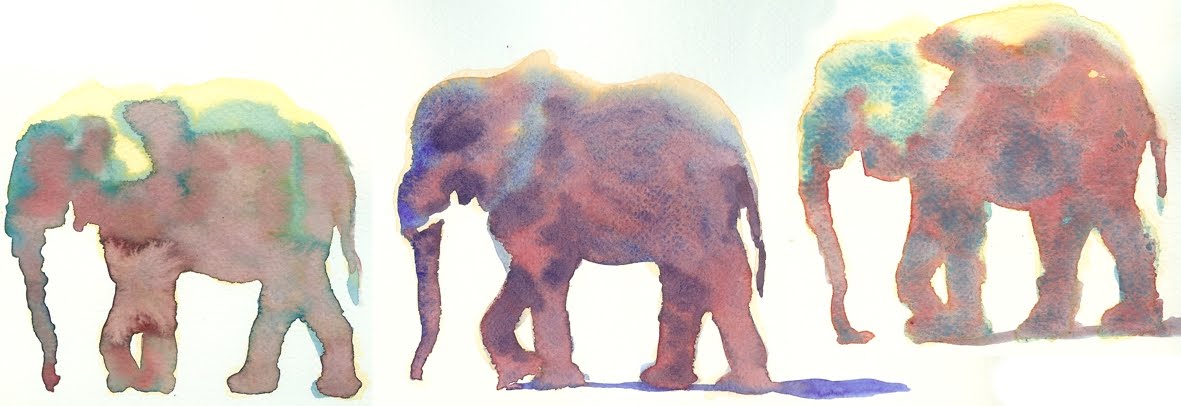
To show this, she painted three versions of an elephant using three different palettes... the first using yellow ochre (semi-opaque, so used only in very thin washes), ultramarine and alizarin crimson - the second using Indian yellow, prussian blue and alizarin crimson and the third - as an experiment - raw umber, transparent turquoise and quinacridone red. With the size of the elephant again determined by the size of the brush she started each one with the palest yellow wash to form the shape, leaving white highlights where the sun struck their backs, then the second wash, paying attention always to tone, then the third dropped into the shadows. To make the dark tones, she mixed a purple/violet with all three colours, in a drier mixture to add definition.
My first elephants were a bit of a sorry affair, so with the next demonstration I tried to follow her method more closely - and ended up with a pale imitation, but all in the pursuit of new skills.I've assembled a series of her steps showing how gently and subtley she builds up washes, each elephant different, concentrating on tone, not colour the whole way through. The front ellies more defined than the back and their feet fading as the dust is kicked up and obscures them. Using the background to bring out the foreground, she mixed stronger greens from the same three colours for the foliage, mixing wet in wet with hard edges to vary it, softening it towards the ground where it's dusty. Reminding us constantly to see "shapes not lines". The demo was photographed in the mirror angled above her workspace. Here, the right way round, Hazel's finished elephant painting.

For the last demonstration of the day, and of the workshop, Hazel brought out a sheet of the Khadi paper that she loves for brighter, bolder wildlife painting - ideal for the lioness' head full of texture and deep colour. This, she says, is no longer a shape, but a block that you have to work within. The interest is in the features. Once they are carefully placed (in pencil) she works within each feature - each one a separate element. Starting with an ear, yellow ochre with burnt sienna dropped into the wet wash, then Winsor violet into the darks, painting with water to bring back whites and letting it flow and settle... "It's not an ear, it's watercolour!" Dropping in sepia to get jet darks, allowing the paint to spread into the dampened outline to look like soft fur.. where she didn't want the paint to spread so far, she used drier paint on the brush. Colours mixed on the paper rather than on the palette. For the eyes to have soft edges, she wet around their shapes and outlined them with sepia, adding yellow ochre and burnt sienna to the middle of the eye so that it 'punched out' the sepia, leaving the all important white spot of eye light.
Hazel's magnificent finished lioness, photographed under less than ideal conditions so looks more subdued than she actually is.
A few final words on Hazel - her dedication to painting and to her priorities are striking and palpable. When I asked if I may blog the workshop, I naively suggested that it may encourage a few more people to register for future workshops, and she told me - very gently - that actually, she has offers from all around the world to hold them in the most wonderful and tantalising places all the time, and she turns most of them down because, first, she wanted to spend time with her son while he was growing up, and because she wants to paint. When we were discussing the internet and Facebook, and she heard of what could be done to promote her name and work on there, she didn't think long before she replied: but it would take so much time away that could be spent painting. Though I 'know' this is what is necessary in theory, it was quite startling to hear that someone would forego travel opportunities like that, to work on her art and passion. Which makes me very grateful indeed that she was persuaded to squeeze this workshop into her busy life and that I squeezed onto it!
Have you nominated your favourite watercolour books on Katherine Tyrell's survey Which are the best art books about watercolour painting? yet? My newly signed copy of 'What shall I paint' will be suggested there soon, as well as one or two others, just got to find a couple more minutes this week!

Tuesday, March 23, 2010

Hazel Soan Workshop Day Three

I should have said Terrific Day Two in that last post, but I started writing it when I was still trying to catch my breath! Onwards now though to...
Enthralling Day Three!
Painting people - something I thought would be quite a breeze as I have drawn and painted so many of them over the years. Don't know if it was the workshop pressure situation or trying to follow Hazel's steps, but I really struggled to begin with as you can see in the top set of figures. Part of the problem was still adding too much water to my washes and not controlling the blending enough ("You are in control!" says HS) But once again I learnt so much and have been rejuvenated and enthused into wanting to paint people as subject matter again, instead of just for 'work'.
We began with figures on white paper as coloured 'silhouettes', as with the ostriches and antelope. Using the size of the brush (an old brush with the point worn down is good in this case) to dictate the size of the head, Hazel made dots and (carefully shaped with brush) dashes to indicate head, arms and legs - hardly worry about the feet, she says, just a touch of shadow to ground the figure. And "to make figures with life... let the watercolours run together... watercolour is beautiful... the reference is just a guide... bad photographs make good paintings... the secret is to make your colour merge..." - some of her running commentary as she effortlessly produced her line of people strolling away, quite ready to go into a frame or a book. Off we went to try and emulate her - and found it was not effortless at all!
On to 'people with props' - umbrellas, baskets, on donkeys or bicycles - are shapes of shade and tone, not separate elements attached to each other, so again allow colours to merge. "Catch or make the attractive shape...Where arms cross the body, leave a white line on top, allow the shadow side to blend in."
Now here is something I'm sure I should have known, but didn't - if your watercolours are transparent they'll blend together, but opaque watercolours will push out and overtake the transparent colour, as in this example where she's indicated a bright pattern on a skirt by touching Cadmium yellow and red into transparent Turquoise. The turquoise on the right was touched in with transparent Indian Yellow, and it immediately blended with the blue to make green. So if you have a 'coloured silhouette' figure, and you want to add a bright punch of colour for pattern or to introduce light, touch an opaque into the wet transparent. If you mix opaques with transparents on your palette, you'll make mud - who knew??!! I bet many of you did, but it's a revelation to me!


Hazel then went on to paint a quick 'reflected light on whites' painting before lunch, using our own Jacques Kallis and Graham Smith as reference - I couldn't believe the vivid aureolin yellow and prussian blue she washed into the 'white' shadows to start with, but by the time she added the bright green grass, it all calmed into a coherent and believable painting of the cricketers. I didn't have time to finish mine, but here is the beginning of it to show how startling are the shadows before they're put into context by the field (mine may be a little more startling than hers). She hardly mixes colours on her palette, mostly allowing them to blend on the paper - "what people love is the watercolour, not the picture of the cricketers!"


After lunch we were faced with the challenge of a closer up figure, with strong highlights. This one really reminded me of my days as a renderer in the ad industry, and I trusted myself a bit more to do it the way I would have with Magic Markers, rather than nervously follow step by step, and actually they are very similiar methods! Leave the highlights white, in with light tone of burnt sienna, carefully forming the shapes in the face, drop in darks of a mixture of burnt sienna and Winsor violet, then the blue shadow value of the shirt, leaving the edges of the glass and the coke can white. Leave highlights crisp, soften and blend in the shadows - add the stripes in a 'pure' colour, in this case, Hookers Green. Add details into glasses, cans, chair (I should have put more colour into his sunglasses) and wash in the background, carefully leaving the highlighted contour of head and shirt. Voila! This is mine - one I was relatively happy with!

Throughout the day Hazel had been egging us on, saying she had so much more to show us, full of excitement and enthusiasm, but by this point we were all fading - she persevered though, with yet another demonstration of strongly lit figures with deep darks contrasting the lights, I don't think any of us attempted this at the end of the day, we were kaput! Here is Hazel's beautiful painting though - when I get to referring to my notes and attempting this project, I'll put it up on the blog too.

Friday, March 19, 2010

Hazel's versions of Day Two!

My versions on Day Two are in the post below this!
These photographs of Hazel's work-in-progress giraffe were taken sitting in front of her demonstration table, which had a mirror angled above it so that we could see exactly what she was doing, brushstroke by brushstroke, as well as her palette and how she mixed her colours - quite sparingly, I was surprised to see.
Step one: Laid down a blue wash for the sky - she used French ultramarine here - pulling it into the shadowed areas on the giraffe's neck and face. Aureolin yellow splattered into the damp wash to indicate trees in the background.
Step Two: A pale yellow ochre wash into the face and down the neck, burnt sienna touched into the ochre to build up the tone and the hue in the face, and sepia touched in on the horns, using the side or the edge of the brush to create the texture of the hairy tips - not painted hairs!
Step Three: Adding the details to the face - shadows from a mix of Burnt sienna and ultramarine in the ears and darks of the eye, with a bit of sepia I think - just one light brushstroke for the eyelash of the far eye! Deepening and softening the shadow down the neck.
Step Four: Adding the pattern onto the neck in burnt sienna, with more ultramarine on the dark shadow side.
She produces her vivid, rich colours knowing exactly how much water and pigment is on her brush. I have always mixed up huge pools of watercolours, sloshing more water in with every brushload and consequently throwing buckets of expensive paint down the plughole - another good lesson learnt!

Tuesday, March 16, 2010

Hazel Soan Workshop Day Two


Nope, sorry - I didn't keep up with my intention of posting every day about the workshop! After trying to absorb all the tons of information - what a generous and totally giving teacher she is - all the concentration and painting, painting, painting for 6 hours a day (plus an hour for lunch) I got home completely exhausted and unable to string two words together.

But now, after a little rest, to continue with...

Phew! Day Two - sketching wildlife - didn't start off well, as I hadn't heard (concentrating too hard on my sunflowers) that it would start half an hour early, and was late. I missed the first demonstration of painting ostriches and didn't have the references printed out, so spent most of the morning flustered, rushing and catching up. In spite of all that, I loved painting these big goofy birds with their shaggy feathers - I think it's a subject I'll go back to when I want to have fun!... I think the lesson was to make the shape of the bird, as with the leaves, using the right size brush to create the neck and legs, and the side of the brush to make the body - dark against light, so just onto the white paper, with colour dropped into the washes.
The next demo was a background wash of ultramarine with a silhouetted shape - in this case, a back lit cormorant - on top of the dry wash using ultramarine and burnt sienna, both non-staining so can be lifted, scraped or touched up with chinese white paint to get back highlights. Again, they were to be "brushstrokes, not birds" - Hazel's were exquisite examples of this - just a flick of the brush across the surface of the paper, and there, perfectly formed, a cormorant poised to dart into flight or to fish....
I'm discovering my washes need lots of work! I haven't been mixing enough paint to cover the whole area, so add water and pigment halfway and cause cauliflowers or cabbages to form... nor have I been mixing it thoroughly, and get streaks and blobs. Too impatient and not enough care!
Then we did a half lit cormorant on a background wash of aureolin and prussian blue(mine far too garish). My second wash was even more blotchy and streaky (though I partly blame - bad workman! - my paper which was old and dry and sucked in all the water). We were to leave a white shape of the highlight on the bird's back, covering all the rest with the wash, then painted the darks of the cormorant over the wash so the shadowed side wasn't separate from the background, then softening into the highlighted area.


Next came painting antelope using a soft yellow ochre wash to identify the overall shape, then laying on burnt sienna, leaving shapes of highlighted areas and dropping in touches of ultramarine in the dark areas. Being these two pigments, again they could be lifted off with a damp brush to reveal more highlights, or the stripes on the kudu - still felt rushed and agitated at this stage and did a rather shoddy job, but here they are anyway! These are all things Hazel paints from life in the bush, in minutes and instinctively, knowing exactly where her colours are and how to render the creature she has in her sights!


Finally for the day, a close up head of a giraffe. You'll see above the stages that Hazel used - I've put it in a separate post so as not to make it look as if I'm trying to pass off her paintings as my own! By this stage I was so tired, willing my giraffe to please, please, not go wrong. I think if it were the only painting I was doing that day, I would have put more into the darks, been more careful with the spots and softened some hard edges, but as it was, I was quite pleased with painting into such a big shape without stuffing it up, and keeping it fairly loose and not overworking anything.
At this point, I think I must remark that, although this may seem like a slavish following of Hazel's methods, they are all techniques that she instinctively uses after her years of experimenting, and her gift to us (I did ask her permission to blog this workshop!) is to take the time and thought to put her natural - though she plans ahead - actions into a sequence that we can use, to paint freely and in our own style once we know a few sound principles and logical steps to produce - as was her aim in this workshop - vibrant, lively watercolours.
Also, some of this I, and I'm sure many of you, do know from our own experiments or reading or lessons, but to have the sequence so clearly laid out when say, presented with a beautiful silhouetted subject on a coloured background, will make painting it much simpler. If you're anything like me you'll be scratching your head thinking, " now, how did I do that last time..?" by which time the bird, or kudu, or whatever, has flown!

Hazel Soan Workshop Day One

I'm halfway through the Hazel Soan's workshop already, and apologise once again for being AWOL for so long. Yesterday I got home too worn out (in a good way) to sit at the computer and record the whole experience, but today I realise if I don't write it up as it finishes, I might never do it, or at least not be able to recall with any clarity each day's activities.
So here, in a nutshell, is what we did on Wonderful Day One:

For this we had to bring an array of various leaves and flowers, as well as some reference photographs that Hazel had specified - reeds back lit against the sky - dark against light, and sunflowers with light coming from the side, so some lost and found edges, background and foreground. Starting with the leaves, she did a demonstration using different sized brushes according to the size and shape of the leaf.

Where Hazel gets her energy I don't know - she had just got off a plane from teaching a workshop in Kenya the night before, and was as fresh and eager to pass on some of her vast knowledge of watercolour as if we were her only students this year. I'm going to be rather disjointed, and just write down little sound bytes of what Hazel said as she demonstrated and walked around the students helping and giving advice, as I am just too tired to organise it all into a comprehensive summary just now.
•Watercolour is perfect, the less you do, the better it is.

•The subject is the excuse to use watercolours - not the watercolours in order to paint the subject.

•Leaves are brushstrokes - we're not painting leaves, we're painting brushstrokes.

•Vary your colours and strokes - entertain the eye.

•Become a slave to TONE - relative tone is the secret of painting - forget matching colour exactly - colour changes according to light and surroundings.
•Paint beautiful patches of watercolour, not 'flowers'
•Order your palette and keep it simple - a warm and a cool - red, yellow, blue. *A note from me - I'm amazed at how spartan her equipment is. We students came with case-loads of tubes and pans, huge water containers and mixing receptacles - she had a paintbox and a tiny bag of tubes to refill it, her brushes, three little water pots and a small bottle of water to replace dirty with clean, and that's it! For all the leaves we used just Aureolin and Prussian blue. For the flower page we added touches of Permanent Rose and Dioxazine Violet. The sunflowers were Indian Yellow and Ultramarine, with Burnt Sienna and Sepia, and a bit of aureolin to vary the greens.
I finally pulled out my stash of beautiful watercolour paper that I've been collecting and hoarding for years, waiting for the time that I could paint well enough to warrant using it, for this workshop and Lo!.. it actually helps one to paint better! Watercolour does what one is hoping it will do a lot more often on lovely paper. My reed painting though, was a total failure - partly because my reference photo was front, not back lit, but my wet-in-wet didn't work, my dry brush didn't scumble, not even the Arches could save it. Ah well.

I'm so pleased to find a fellow Johannesburg blogger, talented Debbie Schiff of Debbie Does Art (love that name!) at the workshop, which reminds me that she and Maree of Art & Creativity passed on the Sunshine Award to me some time ago, and I haven't even acknowledged it here yet, let alone passed it on. Thank you both so much - life has been overtaking me lately - I hope to catch up soon!

Monday, March 8, 2010

Make your own scraperboard

I've been very busy!! Some nice visitors and company, and necessary cleaning up operations beforehand - and I was asked, last year in fact, to make some images for The Stations of the Cross for our church, but I had too much other work on. I thought I'd have plenty of time this year, but once again, it's a rush. I've pondered for weeks on what to do, and how to do it in an economical way, as well as fast and effective. One wee-hours-of-the-morning rumination brought forth the memory of this method of making homemade scraperboard that I learnt years ago in an art class, and which I used to make the above sketch of my daughter - still in a school uniform at the time, so it's a good ten years ago. This is too big for the scanner and in a frame, so not the best reproduction. It's not the sort of scraperboard you can make those perfect, highly detailed illustrations on, but it's great for loose marks and ready-made textures, which are quite a surprise as you pass over various brushstrokes and layers of polish. Here's how you do it, for anyone who's interested...
I did it on fairly heavy paper the first time, but this time I've used Masonite, as it needs to be sturdy and hung easily with string or wire.
  1. Lightly sand the board so paint will stick - this step not necessary on paper support.
  2. Freely paint with white PVA. Don't worry about getting the brushstrokes too smooth if you want texture. Let it dry well and give it another coat if needed. Dry well again.
  3. Apply wax clear floor polish with a soft cloth, let dry, polish lightly and apply another coat. Allow to dry and harden.
  4. Paint on Indian ink with a large soft brush. The wax will resist the ink at first, but keep at it...
  5. After three or four passes and cross-brushing, the ink will stick and cover the white paint
  6. I varied the edges of the boards, leaving some rough and some covered right to the edge.
  7. Allow to dry thoroughly.
  8. Start scratching!

I use a small craft knife to scrape with, which gives me various line widths from very fine to broad depending on how its held, but you can use whatever works best for you. Brush off loose ink that's been scraped off with a soft dry brush.

* A Warning! I got some raindrops splashed on one of my boards, and the ink just lifted straight off. I'm going to have to work out how to seal them to make them less fragile.


I'm not sure if I'll use this hand in the series - it is my hand and although I tried to make it look more masculine (I have pretty workman-like hands anyway), it still looks like mine. Though this was very quick to draw, I need to get scraping, as Easter rushes up - in between my workshop next week and preparations for that, and 100 other things going on right now. I am hoping it will sometimes be a peaceful, meditative Lenten process in spite of the time pressures.