Showing posts with label work in progress. Show all posts

Wednesday, October 25, 2017

Kalahari Bookshop

The Kalahari Bookshop in Orange Grove is a cavern of delights for anyone who would take the time to sift through its groaning shelves, boxes and bookcases to find their particular brand of fascination (or if you're in a hurry, ask the knowledgeable owner Richard for help). I gladly accepted an invitation, along with a few friends, to join artist Tim Quirke in this tucked-away shop's day off - a Monday - to draw in this stacked to the ceiling space. 
Tim was working on a painting, and chatting to us about his methods and approach while the rest of us sketched, as we do, recording the moment in this nostalgic corner of Johannesburg. It was really hard to keep my mind on my sketch when titles that lined my childhood bookshelves kept catching my eye and drawing me to them with squeals of recognition.


After a morning chatting about art, by lunchtime we'd agreed to return over the next few Mondays to continue drawing and painting and learning from Tim the much he has to teach us. So that's what I've been doing over the last three weeks, instead of straightening the house after the weekend, laundry and keeping up with emails and blogging (and Inktober, more of which later), it's been pure indulgence in the world of tone, pattern and observation, which of course is all good!

The sketches below are studies of shape, flow, volume, light and dark, pattern, trying to make sense of the jigsaw of shapes. Hand-toned paper helps to convey something of the feel of the shop and its vintage, well-loved contents as a base for painting on later. While in theory I know of this approach to composition - notan, grouping of lights and darks to form passages - I'm very happy to feel I'm at last starting to figure out, with guidance, how to do it in a real situation...something that's mostly escaped me up to now.


To add to the alchemy, Richard's assistant Arthur kindly sits for us - he could possibly have stepped straight out of one of the books towering over us.
Next on this final (I think!) version, more light and dark passages following the studies above it, and some colour - I'll keep you posted, eventually!

Monday, August 18, 2014

Objets Trouvès 3 W.I.P.


Back in class in May with our 12 colour exercises (see previous post) for inspiration, and having chosen another subject - which had to include both geometric and organic forms, with photographs of it to work from - we were let loose with acrylic paint on three of four big canvases (600x600mm).

We did have some restrictions on each format - on one we were to draw our geometric forms with aids such as rulers with an acrylic line of changing hues, and then washes or glazes of pure hues, pulling back with a cloth to reveal shapes and textures (pic 2).
On another we made shapes and textures by any means other than brushstrokes - printing with textured surfaces, rolling on colour with cloth or plastic, splashing, spraying or slapping (pic 1) and transferring some of this wet mélange onto the third canvas, where colour, shape and texture was further achieved through stencils and transfers (pic 3) This last one changed completely from the way it appears here, but I forgot to take more photos until much later in the process.

So this was mostly a lot of liberating fun and playtime, especially for someone like me who tends to get pernickety about rendering things (that comes later!) I had chosen a very simple image - the bird bath in our garden with some brickwork and foliage behind and reflected in it - and was getting worried that I would be spending the rest of the year painting my bird bath.... I still am but with so many surprises and interventions in store, it's hardly recognisable - but I'll get to that eventually.

Tuesday, November 13, 2012

End of the Dinner Party

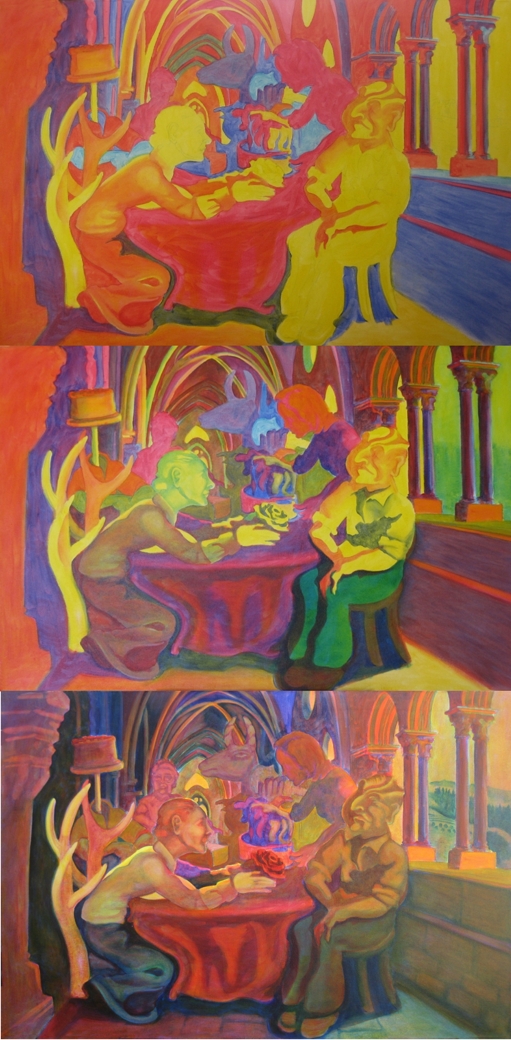
 I've just come to the end of this year's Greg Kerr (website currently under construction) painting course, "The Dinner Party", which once again has been a fascinating, informative and unpredictable ride through the world of painting, art and artists, as well as really fun, sociable interludes throughout the year.

It started with researching and making Valentine cards for 5 artists, plus yourself, as preparation for the course. During the first week we painted place settings for each one in acrylic, glazed and embellished later if needed in oils. As prep for the following session we had to make and photograph clay models of the artists at a dinner table, in a setting, which we drew up carefully and painted in class onto one canvas and freely painted onto a second, using oil glazing methods.

In September, we were introduced to a process called Decalcomania, where we covered our place-setting paintings with plastic, repainted the images thickly in primary and secondary colours in acrylic, and then quickly transferred to a new canvas of the same size, repeated as many times as was necessary for a rich textured surface. This process produced unexpected and random results; blobs, blotches, textures, misregisterings, all of which were part of the grand plan.

On these printed images we were to cool down and warm up chosen areas (Mavis and Fred in Greg's unique terminology!) to make them recede or come forward, and then go through a list of possible interventions to challenge us, develop a dialogue with the work, and create an interesting patina and history - including more decalcomania, patterning, glazing, shadows, wet-in-wet and dry brush painting.

The entire project has upended my 'normal' way of doing things - which I welcome wholeheartedly, bored as I often get with my faithful renderings of things and people - but challenging and perplexing it certainly is...and am still busy with, so no final results to show you as yet, but here are some pictures of the process so far.


Sunday, May 13, 2012

Dinner Party Work-in-Progress


After an intense four days of painting on two 1200x800mm canvases last week, there is still a way to go on both of them. Here's what's happened since the clay figures I made... the six figures were arranged around a table and put in a setting. I put plain cardboard walls around them after failing to make a convincing stage set and afraid the whole thing would crash down and further destroy my crumbling people, then lit the scene in various ways to take as many interesting photos as possible (the possibilities were endless!) I digitally cut some of my figure arrangements out and pasted them onto photo backgrounds, finally settling on one of a ruined cathedral in Lisbon that my husband took when I was busy with the Urban Sketchers Symposium last year, and he and our son were sight-seeing. We were to draw up this design onto one canvas and leave the other blank.

On Monday morning our painting group gathered excitedly, nervously, or both - we knew we were in for a week of hard work and plenty of surprises. Greg informed us that we would be painting two large paintings in the four days, immediately creating a sense of urgency/disbelief/panic. The drawn up canvas was to be glazed with primary colours, randomly in sections, then glazed again with the primaries to create secondary colours. While that was drying, the other canvas was covered with a glaze in a colour of our choice, lifting out areas freehand where we wanted lighter or back to a previous colour, using our photos. Both methods similiar to what we did last year in the Dark Cloud workshops. The glazing and lifting  on both paintings continued, building tones and secondary, tertiary and strangely indescribable other colours.
They're not finished yet - mine are extremely weird, not your average portrait group but so interesting to me in subject, process and unexpected results - I will forge on with them and see where we end up. I wish I could show you all the paintings that were produced, each so different and with their own unique qualities, a real credit to the teaching to produce such a range of individual responses to the project.


Tuesday, May 17, 2011

Resurfacing...

It's been a long time! My apologies and thanks to all who have left comments over the last few posts, gone mostly unanswered, though not ignored - I have read and appreciated every one of them.
I thought this year would be a slow, relaxed stretch of time for sketching and painting, now that my son has finished school and no longer requires as much taxiing around and motherly ministrations (wrong about that too!), but it has spiralled into a maelstrom of activity. When I started this blog, it was partly to motivate myself to make art regularly - in that respect it has succeeded, and then some!

I mentioned some time ago that I registered for a year long course with artist and lecturer Greg Kerr. Four sessions of four days each, spread over the year with the surprise addition of plenty of homework in between. We're half way through that now, having just completed the second session.
The first entailed preparation of sourcing our own images through a programme that Greg and other university lecturers developed called 'The Dark Cloud', from which we made large charcoal triptychs.
Each panel is a full sheet - of Arches hot press 300gsm in my case - at the moment being displayed in the David Brown Gallery in Nelson Mandela Square in Sandton with eleven other student's work - a credit to Greg's teaching that all the work is so different, individual and good! It was chosen not on any merit system but merely those who had finished and submitted in time.
For homework we had to make 24 very small images from cropped sections from the source material photographs - I still have 6 to go (relieved to find we weren't in for detention or a rap on the knuckles for non-completion!)

These are on A6 sheets of Fabriano, with the images 120x85mm, and are meant to force the charcoal to be as photographic in nature as possible. When all are done, to be bound into a book form.

In the second session we took three of these tiny images and blew them up to large canvas size to make tonal studies in acrylic paint, with added interest of thin coloured edges - I left some areas of the canvas showing the coloured underpainting, with lots more thinking and work still to be done on them - very much work in progress.
I began the first full-tonal range panel on a big canvas - 1000x800mm but switched to smaller 550x750mm ones for the high and dark toned ones after I'd spent the first day filling in between the lines. Not sure where these are going yet, but I have no doubt there will be surprises in store the next time we get together in August for oil painting.

A big advantage of a course spread out like this over a period is that you learn to live with your work, think about and develop it, as well as the discipline of returning to it - to become a habit by the end of the course, instead of the workshop becoming a pleasant, but dim and distant memory - at least that is what I hope happens.

But wait, that's not all I've been doing! In between this was another short watercolour workshop that I'll write about soon, the Urban Sketcher's Symposium rushing up and needing attention - some preparation under my belt but lots more to do - a workshop that I've just given on sketchbooks and art journals, the lovely postcard exchange which deserves more time and effort... how did this all land up in the same year, I'm sure it could keep me going for five!

Thursday, July 17, 2008

End of Eggshells

That's it folks - I decided to go the whole hog, seeing it had gone a bit haywire anyway, and paint in the decorative edge of the plate, which I did quite quickly with dots and dashes, though it may look painfully intricate (and pretty skew)! Thanks for all your encouragement - I do think I learnt a lot - but realise I have much more to learn about reflections and shadows, and that Andrew Wyeth was right, as Sandy Maudlin told in a comment, that eggs and ears probably are the hardest things to paint. I went to a watercolor workshop once, where our homework was to paint an egg, a bone and a rock, and I thought I had it taped - the secret, I told anyone who admired my egg, was not to draw a pencil outline first, but to use the brush edge to swoop around the egg shape - well, let's just say there's more to it than that...
[In the middle of this project, I puzzled over why my 'still-life' looked so different to what I had on the paper - then it dawned on me that one of our resident cooks had deposited a few more eggshells on the plate, probably thinking crazy mother was just collecting them for some other arty pursuit (I've been painting in the kitchen, being the warmest room in the house right now.) Ha ha ha!]

Tuesday, July 15, 2008

How not to paint reflections - Part two of Eggshell WIP

Aaargghhh! I did stuff it up - I made my nice clean washes into mud and murky browns by putting too strong darks too soon and then making it worse worrying at it instead of going away and letting it dry. Nothing like displaying one's failures to all and sundry (I hope you all learn from this!)
After I finally let it rest and dry, I lifted some of the murk and at last followed Laura's sensible suggestion (see comments on previous post) to work a bit more on the eggshells before going back to those #*!* shadows. If nothing else this work-in-progress exercise will serve to remind me what not to do in future. I will take Jana's serene advice in her interview with Liz Massey to learn from the experience, let it go and move on. But I will keep on at this for a while longer, until I've either rescued it, or am totally satisfied that I've utterly botched it.

Sunday, July 13, 2008

Walking on eggshells

I've decided to follow Laura's example and show my eggshells painting that I mentioned in the last post, as a work in progress, but do be aware, anyone who may take this as a step-by-step watercolour class, that it may go awry at any moment! I intended building layers of clean glazes to create subtle colour variations, but I already haven't been able to resist mixing some local colour and slapping it on. Above is the initial glaze of yellow ochre, with a little burnt sienna, with some shadow areas of burnt sienna with ultramarine mix. I lifted highlights out in places with a 'thirsty' brush and paper towel.
When that was completely dry I added more shadow washes, trying to vary them with the slight mauve and yellowish tinges I kept seeing. Those shadow/reflections in the foreground are really very dark against the plate and shells, so the next stage is taking some bold steps with a strong shadow mixture. I'm undecided whether to paint the plate as it is - an intricate cutout design around the edge, or leave it quite plain, which I probably should have thought about before I began. Any advice welcome!